Generative AI for Legal and Regulatory Compliance
Bluetab developed a Generative AI platform for an energy company to automate the reading, analysis, extraction, and tracking of permits and regulatory obligations across eight operating plants. The solution reduced time spent reviewing and contextualizing documents by 85% while improving traceability and real-time visibility into compliance status.
Automating Legal & Regulatory Compliance with Generative AI
Bluetab developed a Generative AI platform for an energy company to automate the reading, analysis, extraction, and tracking of permits and regulatory obligations across eight operating plants. The solution reduced time spent reviewing and contextualizing documents by 85% while improving traceability and real-time visibility into compliance status.
The Challenge
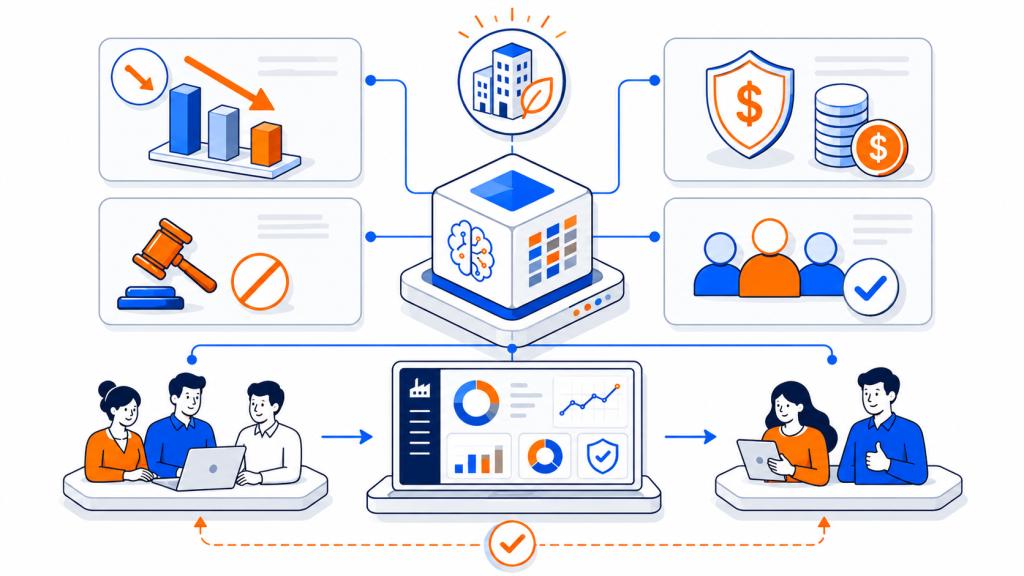
The client managed international, national, state, and municipal permitting requirements across eight operating plants. Documents had validity periods ranging from six months to several decades, while legal, environmental, and commercial teams worked in a decentralized model using notebooks, Excel, email, and SharePoint. This created fragmented information, limited traceability, unclear ownership, and exposure to non-compliance.
- Complex documents containing signatures, tables, diagrams, and specialized terminology.
- Varying validity periods and frequent regulatory changes.
- Manual processes prone to human error and specialist teams spending excessive time on administrative work.
- Potential multimillion-dollar fines, operational shutdowns, and significant reputational and financial exposure.
- Resistance to change and complex dependencies across parent, child, and grandchild documents.
The Solution
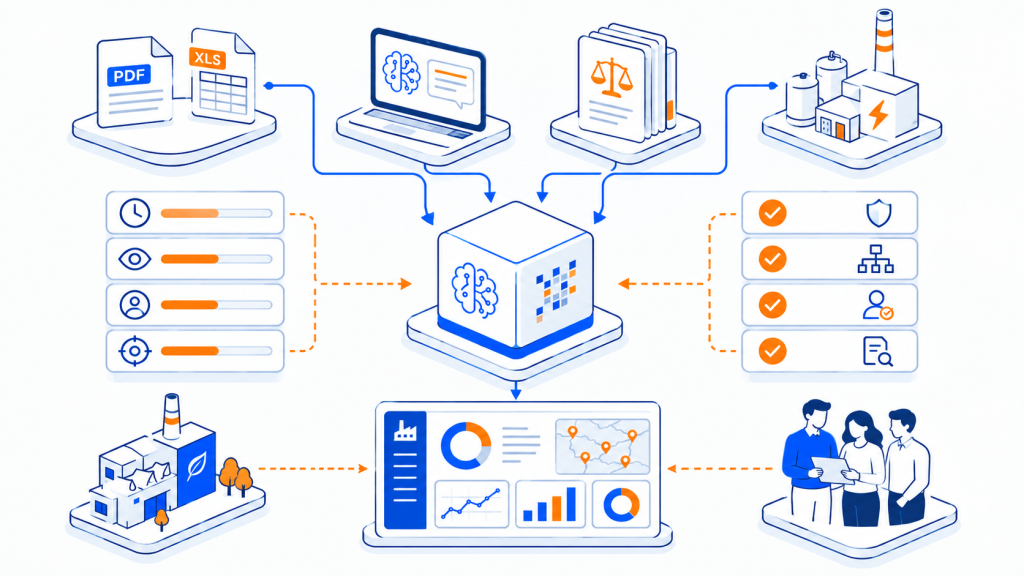
Bluetab developed a Generative AI platform for legal and regulatory compliance on the client’s Azure Databricks infrastructure. The platform automates reading, analysis, extraction, and tracking of regulatory obligations, combining advanced AI capabilities with a user-centered adoption approach.
Key Capabilities / Components
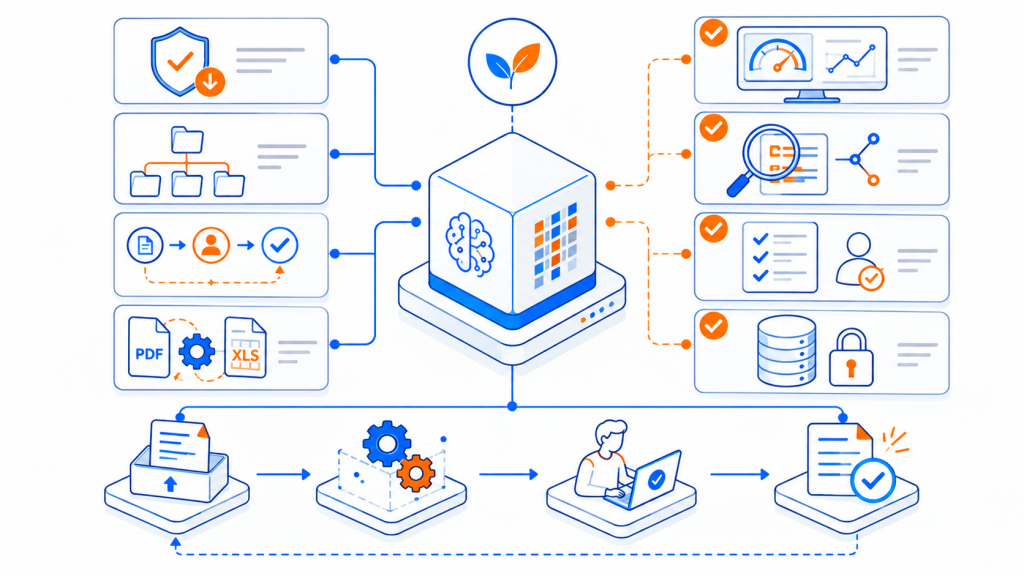
- RAG architecture combining information retrieval with natural-language generation.
- GPT models for embeddings and Anthropic cloud models for conversational interactions.
- Multi-format processing across PDF and Excel files, extracting signatures, reference numbers, dates, and responsible parties.
- Tree-based document hierarchies for parent and child licenses and their dependencies.
- Azure AI Search as the vector search layer and Cosmos DB for unstructured data storage.
- Clearly defined roles across data capture, audit, and final validation.
- Design Thinking workshops, executive sponsors, change ambassadors, and a dedicated identity selected by users.
Business Outcomes
- Reduced time spent reviewing and contextualizing documents by 85%.
- Enabled real-time, 360° visibility into permits and regulatory obligations.
- Reduced the administrative burden on specialist teams.
- Achieved high accuracy in document abstraction, measured through retrieval metrics.
- Significantly reduced exposure to regulatory penalties and operational shutdowns.
- Improved dependency tracking through hierarchical document structures and established a deterministic workflow with human validation.
- Automated metadata processing across PDF and Excel.
- Projected a 35% reduction in financial risk across 50 monitored documents.
- Estimated preventive value of USD 10,000 per critical permit.
- Set an explicit goal of reducing fines to virtually zero.
- Drove organization-wide adoption through co-creation, executive sponsors, and change ambassadors.
Next Steps / Expansion
- The same platform is already being used to process bank guarantees, financing agreements, indentures, and secured bond issuances, demonstrating potential beyond legal compliance as a cross-functional document-analysis engine.
FAQ's
How can Generative AI support regulatory compliance?
It can automate the reading, analysis, extraction, and tracking of regulatory obligations while improving traceability and visibility across complex document environments.
What measurable efficiency improvement did the project achieve?
The use case reports an 85% reduction in time spent reviewing and contextualizing documents.
Was the 35% financial-risk reduction already achieved?
No. The PDF describes a projected 35% reduction in financial risk across 50 monitored documents.
What technologies support the compliance platform?
The documented architecture includes Azure Databricks, RAG, GPT models for embeddings, Anthropic cloud models, Azure AI Search, and Cosmos DB.
Can the platform be used beyond legal compliance?
Yes. The same platform is already being used to process financial documentation such as bank guarantees, financing agreements, indentures, and secured bond issuances.